 The contents of this website, unless otherwise stated, are licensed under a Creative Commons Attribution 4.0 International License.
Connect to our community on:\r\nforum.opendata.ch\r\n| twitter\r\n| facebook\r\n
\r\n\r\nThe contents of this website, unless otherwise stated, are licensed under a Creative Commons Attribution 4.0 International License.

 \r\n
\r\nTabula Peutingeriana, 1-4th century CE. Facsimile edition by Konrad Miller, 1887/1888
\r\n\r\nToday, HTML and its geolocation API provide a lightweight, yet powerful tool to precisely locate any device all over the world. Modern maps, open data DEMs (digital elevation models) and Extended Reality frameworks can be combined in order to create virtual worlds (see last year's Swiss Open Cultural Data Hackathon project swissAR) and geographical information systems.\r\n\r\nhelvetiX aims at providing an immersive Virtual Reality guide for any Roman merchant or legionary when travelling to ancient Helvetia. (In Latin, of course.)\r\n\r\n \r\n
\r\nPratobornum (Zermatt), 1047 double steps away: Screenshot from the helvetiX prototype.
\r\n\r\n \r\n
\r\n Instructions
 Contact author
 Back to current position
 1000 double steps up/down
 1000 double steps forward
3D model of Switzerland, on a 1:1 scale, based on a 200 meter grid, in glb format. (Source: Swiss Federal Office of Topography swisstopo)
\r\n\r\nif (navigator.geolocation) { // ask for user permission to retrieve user location
\r\n navigator.geolocation.getCurrentPosition(function(position) { // callback function success, set coords to user location
\r\n var b1=position.coords.latitude∗3600; // calculate swiss coords
\r\n var l1=position.coords.longitude∗3600;
\r\n var b2=(b1-169028.66)/10000;
\r\n var l2=(l1-26782.5)/10000;
\r\n var n=200147.07+308807.95∗b2+3745.25∗Math.pow(l2,2)+76.63∗Math.pow(b2,2)+119.79∗Math.pow(b2,3)-194.56∗Math.pow(l2,2)∗b2;
\r\n n+=1000000; // omit if using LV03 format
\r\n var e=600072.37+211455.93∗l2-10938.51∗l2∗b2-0.36∗l2∗Math.pow(b2,2)-44.54∗Math.pow(l2,3);
\r\n e+=2000000; // omit if using LV03 format
\r\n }, function () { // callback function error
\r\n ...
\r\n });
\r\n}Math.round(num)>0, as there is no zero in the ancient Roman numeral system) can be converted to Roman numerals byfunction romanize(num) {
\r\n if (isNaN(num/1.48176))
\r\n return NaN;
\r\n var digits=String(+num).split(\"\"),
\r\n key=[\"\",\"C\",\"CC\",\"CCC\",\"CD\",\"D\",\"DC\",\"DCC\",\"DCCC\",\"CM\",
\r\n \"\",\"X\",\"XX\",\"XXX\",\"XL\",\"L\",\"LX\",\"LXX\",\"LXXX\",\"XC\",
\r\n \"\",\"I\",\"II\",\"III\",\"IV\",\"V\",\"VI\",\"VII\",\"VIII\",\"IX\"],
\r\n roman=\"\",
\r\n i=3;
\r\n while (i--) roman=(key[+digits.pop()+(i*10)] || \"\")+roman;
\r\n numeral=Array(+digits.join(\"\")+1).join(\"M\")+roman;
\r\n}\r\n---\r\n Project Documentation (work in progress): \r\n\r\nFriday, 16.4.2021 //
\r\n11:00h: Group forming.
\r\nTeam members:
\r\nSaro Pepe Fischer
\r\nElias Kreyenbuehl
\r\nJan Sandberg
\r\nMichel Piguet
\r\nKenny Floria
\r\n\r\n13:00h: First tests with implementing the historical Pics of Ruef-Hirt in maps and 3D applications:
\r\n\r\n\r\n
\r\n\r\n
\r\n\r\n
\r\n15:00h: Decision to narrow the project down to the city's quarter \"Aussersihl Inustrie\" and especially the \"Langstrasse\".\r\n
\r\n15:45h: A first milestone, this newly generated map with the historical pictures:
\r\nhttp://glamhack21.kennyfloria.ch/
\r\nCode to the map-/picture-application:
\r\nhttps://github.com/PaulKC/glamhack2021-a-walk-trough-zurich-around-1910
\r\n16:30h: Remodelling pictures for integration in a 3D-view:
\r\n\r\n
\r\n
\r\n\r\n
\r\n\r\n
\r\n22:30h: Implementing the 1913 city map as a new background:
\r\n\r\n\r\n\r\n\r\n
\r\n
\r\nSaturday, 17.4.2021 //
\r\n09:30h: Presentation of the implementing of the 3D-model of the City of Zurich (real Buildings) for the filmic walk through \"Langstrasse 1906\":
\r\n\r\n
\r\n
\r\n\r\n
\r\n
\r\n13:30h-15:00h: Fighting the video programmes and trying to render, edit and export the files. We are getting there...
\r\n15:30h: Putting all the pieces together for the short 90 second movie.
\r\n16:30h: Link to the video: https://drive.google.com/file/d/1l6BIubsoJQMlxY1kj_V3a7uMkOP2LlGh/view","maintainer":"SaroPepe","name":"A walk trough Zurich around 1910","phase":"Challenge","progress":0,"score":92,"source_url":"https://github.com/PaulKC/glamhack2021-a-walk-trough-zurich-around-1910","stats":{"commits":0,"during":43,"people":1,"sizepitch":5186,"sizetotal":5297,"total":65,"updates":63},"summary":"Following the paths of Friedrich Ruef-Hirt discovering his fascinating photographs taken between 1905 and 1910.","team":"SaroPepe","team_count":1,"updated_at":"2021-04-17T15:52","url":"https://hack.glam.opendata.ch/project/23","webpage_url":"http://glamhack21.kennyfloria.ch"},{"autotext":"GLAMhack 2021 - Culture inTime \n=========================\n\nGLAMhack 2021 provided the opportunity to continue working on Culture inTime, a sandbox for adding and visualizing Performing Arts Production metadata in a simple calendar-like user interface. Culture inTime was first developed during GLAMhack 2020. A few features have been added: \n* Anyone with the right skills can now add their own SPARQL queries of existing linked open data (LOD) sources\n* Anyone can now configure their own Spotlights based on data sources in Culture inTime\n\nCulture inTime continues to put its focus on Performing Arts Productions. Go to https://culture-intime-2.herokuapp.com/ to try it out!\n\nTypes of Users\n=========================\n* Power User: Can create SPARQL queries and Spotlights on data.\n* Spotlight Editor: Creates Spotlights on data. \n* Browser: Uses Search functionality and pre-configured Spotlights to peruse data. \n\nData Sources\n=========================\nIn the section called Data Sources, power users can add their own SPARQL queries of existing linked open data (LOD) sources to Culture inTime. The only prerequisties are:\n* Technical expertise in creating SPARQL queries\n* Knowledge of the graph you want to query\n* Login credentials (open to all) \n\nTwo types of SPARQL queries can be added to Culture inTime\n* Queries to add names of Performing Arts Productions. These queries are limited to the performing arts production title and basic premiere information.\n* Queries to add supplementary data that augments specific productions. Supplementary data can be things like event dates, performers, related reviews and juxtaposed data (examples are indigenous territorial mappings, cultural funding statistics). Supplementary queries are loaded on the fly and always attached to one or more Performing Arts Production queries.\nTo learn more about how to add queries, see the Technical Guide.\n\nDifferent contributors are continuously adding and building on data sources. To see what's been added, go to https://culture-intime-2.herokuapp.com/data_sources.\n\n\nSpotlights\n=========================\nSpotlights group together productions around a theme. They can span time, locations and data sources. Once you create a login, creating spotlights is easy with a new form that allows Spotlight Editors to choose their parameters and then share their spotlight with the community. Basic editorial functionality is available. To see some Spotlights, go to https://culture-intime-2.herokuapp.com/spotlights.\n\n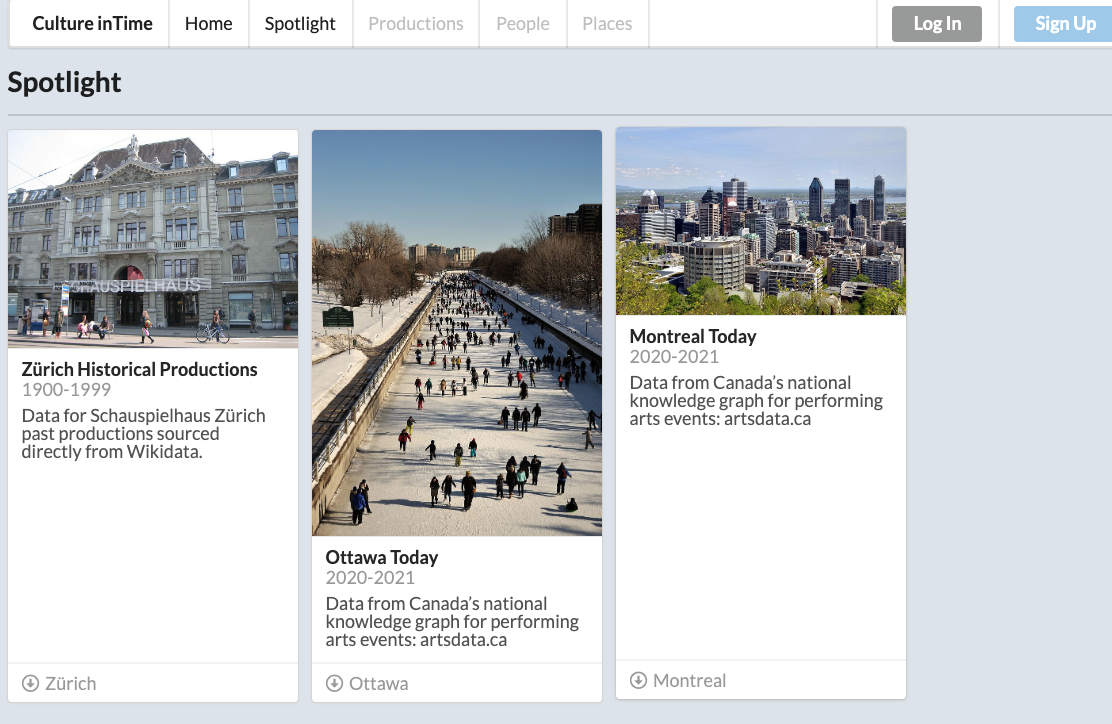\n\nTechnical Guide\n========================\nTo add Spolights or a new data source using SPARQL, please consult this [Google Doc](https://docs.google.com/document/d/1ht17HeUmt-TXJIk139XP4usTn1AV5boWFoSmFw53q-w/edit?usp=sharing) \n\nGLAMHACK 2020\n=========================\nThis 2020 GlamHack Challenge resulted from the discussions we had earlier this week during the workshops related to performing arts data and our goal is to create a Linked Open Data Ecosystem for the Performing Arts.\n\nSome of us have been working on this for years, focusing mostly on data cleansing and data publication.\nNow, the time has come to shift our focus towards creating concrete applications that consume data from different sources.\nThis will allow us to demonstrate the power of linked data and to start providing value to users.\nAt the same time, it will allow us to tackle issues related to data modelling and data federation based on concrete use cases.\n\n\u201cCulture InTime\u201d is one such application. It is a kind of universal cultural calendar, which allows us to put the Spotlight on areas and timespans where coherent sets of data have already been published as linked data. At the same time, the app fetches data from living data sources on the fly. And as more performing arts data is being added to these data sources, they will automatically show up.\nIt can:\n- Provide a robust listing of arts and cultural events, both historical and current. Audiences are able to search for things they are interested in, learn more about performing arts productions and events, find new interests, et cetera.\n- Reduce duplication of work in area of data entry\n\nThe code is a simple as possible to demonstrate the potential of using LOD (structured data) to create a calendar for arts and cultural events that is generated from data in Wikidata and the [Artsdata.ca](http://artsdata.ca) knowledge graph. \n\nThe user interface is designed to allow visitors to search for events. They can:\n- Use the Spotlight feature to quickly view events grouped by theme.\n- Use Time Period buttons to search a time period.\n- Use a Search field to enter a search using the following criteria: name of production, theatre, city, or country.\n- Visit the source of the data to learn more (in the example of an Artsdata.ca event, Click Visit Event Webpage to be redirected to the Arts Organization website.\n\nNote: Currently when you enter a location, data only exists for Switzerland and Canada (country), Zurich, Montreal/Laval/Toronto/Vancouver/Fredericton and some small villages in Quebec. \n\nSearch results list events sorted by date.\n\n\nChallenges\n=========================\nData is modelled differently in Wikidata, Artsdata, and even between projects within the same database.\nData has very few images.\n\nMore UI Images\n=========================\nSpotlight Page\n\n\n\nEvent Details page - Montreal\n\n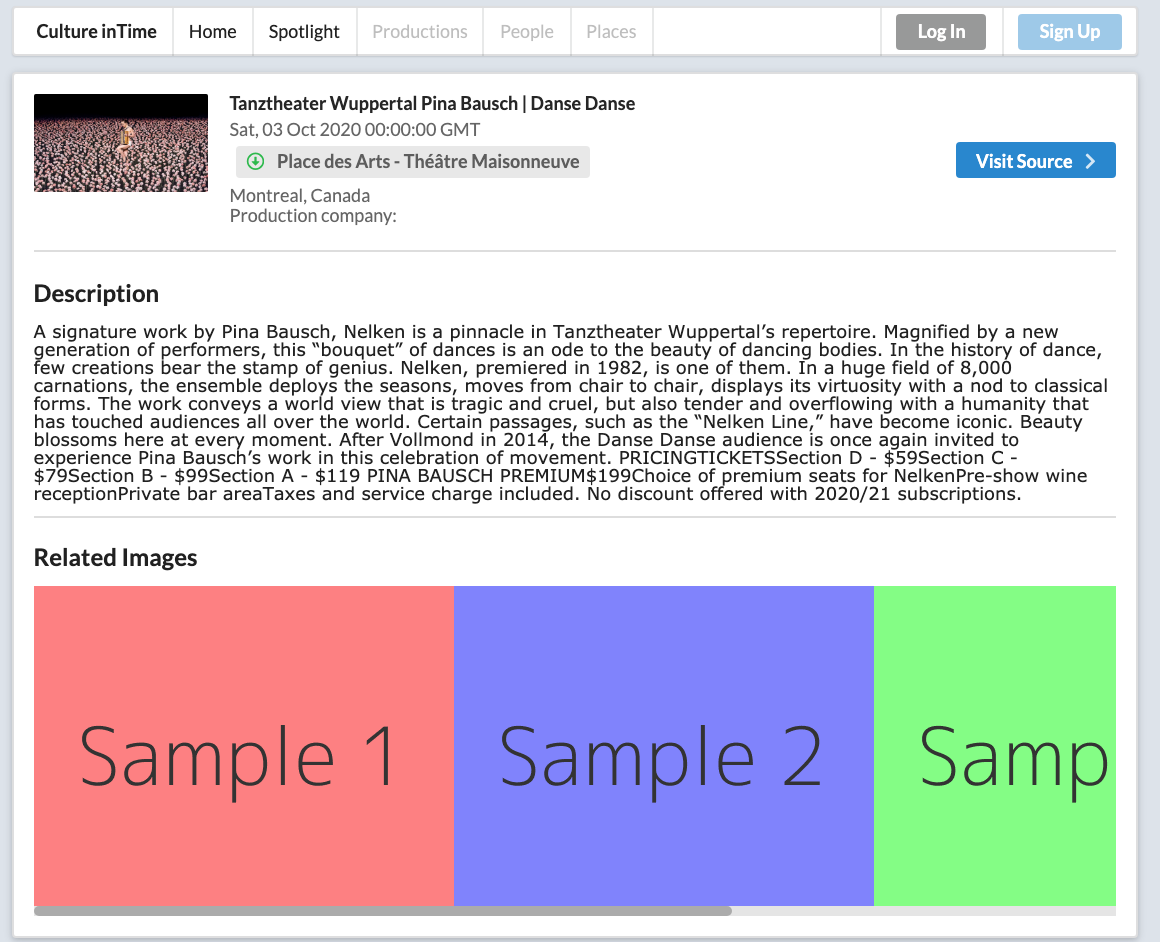\n\nProduction Details page - Zurich\n\n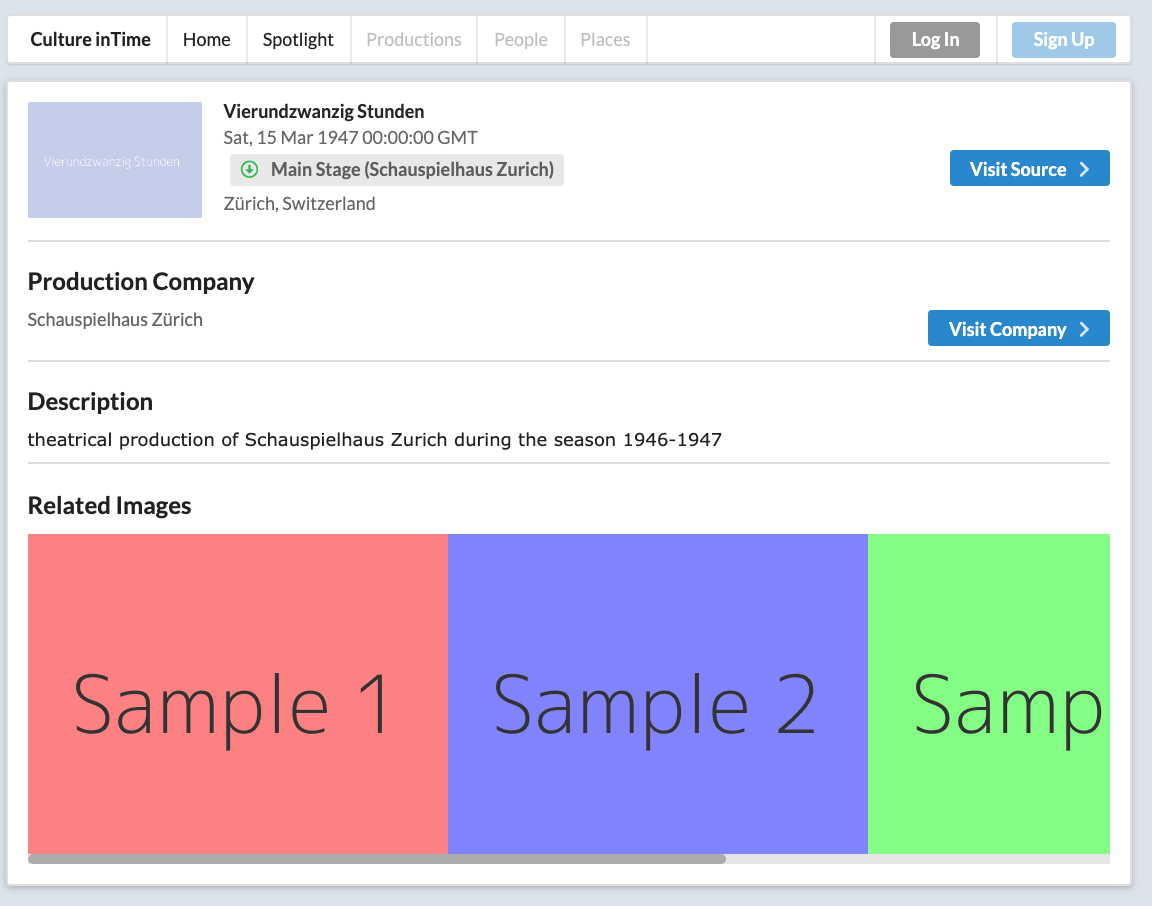\n","autotext_url":"https://github.com/culturecreates/Culture-inTime","category_id":"","category_name":"","contact_url":"https://github.com/culturecreates/Culture-inTime/issues","created_at":"2021-04-09T15:39","download_url":"","event_name":"GLAMhack 2021","event_url":"https://hack.glam.opendata.ch/event/2","excerpt":"GLAMhack 2021 - Culture inTime \n=========================\n\nGLAMhack 2021 provided the opportunity to continue working on Culture inTime, a sandbox for adding and visualizing Performing Arts Production metadata in a simple calendar-like user interface. Culture inTime was first developed during GLAMhack 2020. A few features have been added: \n* Anyone with the right skills can now add their own SPARQL queries of existing linked open data (LOD) sources\n* Anyone can now configure their own Spotlights...","hashtag":"","id":73,"ident":null,"image_url":"https://avatars.githubusercontent.com/u/419491?v=4","is_challenge":false,"is_webembed":false,"logo_color":"","logo_icon":"","longtext":"","maintainer":"saumier","name":"Culture In-Time 2","phase":"Share","progress":50,"score":91,"source_url":"https://github.com/culturecreates/Culture-inTime","stats":{"commits":0,"during":0,"people":5,"sizepitch":0,"sizetotal":5990,"total":14,"updates":8},"summary":"Simple event calendar for public viewing of performing arts productions past and future.","team":"saumier, Iconoclaste, Caitlin, kim, beatestermann","team_count":5,"updated_at":"2021-04-20T16:40","url":"https://hack.glam.opendata.ch/project/73","webpage_url":"https://culture-intime.herokuapp.com"},{"autotext":"","autotext_url":"","category_id":"","category_name":"","contact_url":"https://github.com/parisdata/2021GLAMHACK/issues","created_at":"2021-04-16T05:18","download_url":"","event_name":"GLAMhack 2021","event_url":"https://hack.glam.opendata.ch/event/2","excerpt":"The goal is to create an easy-to-use online tool that analyses provenance texts for key indicators: UNCERTAINTY, UNRELIABILITY, ANONYMITY and RED FLAG.\r\n\r\nThe user uploads the file to analyse, and the tool enhances the file with quantitative information about the provenance texts.\r\n\r\nTry it out! https://artdata.pythonanywhere.com\r\n\r\n\r\n","hashtag":"","id":112,"ident":null,"image_url":"https://bucketeer-036aa605-c047-4623-8610-f1764b90cf98.s3.amazonaws.com/glamhack/5R3LPDDPWH288EAUQHD82AIG.png","is_challenge":false,"is_webembed":true,"logo_color":"","logo_icon":"","longtext":"The goal is to create an easy-to-use online tool that analyses provenance texts for key indicators: UNCERTAINTY, UNRELIABILITY, ANONYMITY and RED FLAG.\r\n\r\nThe user uploads the file to analyse, and the tool enhances the file with quantitative information about the provenance texts.\r\n\r\nTry it out! https://artdata.pythonanywhere.com\r\n\r\n\r\n","maintainer":"LaZu","name":"Deploy Looted-Art Detector","phase":"Share","progress":50,"score":91,"source_url":"https://github.com/parisdata/2021GLAMHACK","stats":{"commits":0,"during":21,"people":2,"sizepitch":454,"sizetotal":548,"total":24,"updates":21},"summary":"Make it easy for anyone to use the Looted-art Detector we created at last year's Glamhack2020. ","team":"LaZu, rae_knowler","team_count":2,"updated_at":"2021-04-17T14:36","url":"https://hack.glam.opendata.ch/project/112","webpage_url":"https://artdata.pythonanywhere.com"},{"autotext":"# Nachtschicht21 (GLAMHACK2021) \n- Interactive Virtual Reality 3d Exhibition \n\n## Goal\n\nExplore and discover the possibilities of A frame has to offer for a VR immersive experience.\n\n## Project Description \nThe initial concept was to transform the content from the website [Nachtsicht21](https://www.nachtschicht21.ch/) into a more immersive experience with the use of Virtual reality visualisation means. \n\nAfter some discussion, the team decided to bring the user in a space framework and to dispose paintings in this colourfull environment such as if they were forming a new constellation. \n\nIn addition, some animation were associated to each painting to allow the visitor to better appreciate the images on the the panels. \n\n## Screenshots\nHere are some screenshots from the designing process of the VR environment: \n\n\n\n\n\n## Weblinks\nhttps://353893-4.web1.fh-htwchur.ch/im4/Nachtschicht21/index_5.html\n\n\n\n","autotext_url":"https://github.com/Nachtschicht21/Nachtschicht21","category_id":"","category_name":"","contact_url":"https://glamhack2021.slack.com/archives/D01UULM1BB2","created_at":"2021-04-16T06:33","download_url":"","event_name":"GLAMhack 2021","event_url":"https://hack.glam.opendata.ch/event/2","excerpt":"Nachtschicht21 https://www.nachtschicht21.ch/ is curating artworks of young swiss contemporary artists. During this hackathon we'd like to create beside the gallery exhibition, which will start on the 11.5.2021, a VR space, in which the works can be made accessible to everyone around the globe. This we plan to do with A Frame.\r\n\r\nData to work with during the two days hackathon:\r\nhttps://drive.google.com/drive/folders/1_6AoAPutT2V7uh6ZE9W9S1OJwklS3KWF?usp=sharing\r\n\r\nSoMe-channel of Nachtschicht 2...","hashtag":"","id":113,"ident":null,"image_url":"https://avatars.githubusercontent.com/u/82229332?v=4","is_challenge":false,"is_webembed":false,"logo_color":"","logo_icon":"","longtext":"Nachtschicht21 https://www.nachtschicht21.ch/ is curating artworks of young swiss contemporary artists. During this hackathon we'd like to create beside the gallery exhibition, which will start on the 11.5.2021, a VR space, in which the works can be made accessible to everyone around the globe. This we plan to do with A Frame.\r\n\r\nData to work with during the two days hackathon:\r\nhttps://drive.google.com/drive/folders/1_6AoAPutT2V7uh6ZE9W9S1OJwklS3KWF?usp=sharing\r\n\r\nSoMe-channel of Nachtschicht 21\r\nhttps://www.instagram.com/nachtschicht21/\r\n\r\n\r\n\r\n\r\n","maintainer":"Geruscha Lau FHGR","name":"Nachtschicht 21 a 3D, Virtual Reality & Art Exhibition","phase":"Launch","progress":40,"score":89,"source_url":"https://github.com/Nachtschicht21/Nachtschicht21","stats":{"commits":0,"during":6,"people":1,"sizepitch":544,"sizetotal":1805,"total":10,"updates":8},"summary":"We want to showcase the artworks of swiss contemporary artists in a VR space.","team":"Geruscha Lau FHGR","team_count":1,"updated_at":"2021-04-17T14:38","url":"https://hack.glam.opendata.ch/project/113","webpage_url":""},{"autotext":"","autotext_url":"","category_id":"","category_name":"","contact_url":"https://www.performing-arts.ch/resource/sapa:About","created_at":"2021-03-27T18:18","download_url":"","event_name":"GLAMhack 2021","event_url":"https://hack.glam.opendata.ch/event/2","excerpt":"Ursula Pellaton (*1946) is a walking encyclopedia of Swiss dance history. Her enthusiasm for dance began in 1963 with a performance of \"Giselle\" in Zurich. That was the beginning of her many years of involvement with dance, which has accompanied her ever since as a journalist and historian, among other things.\r\n\r\n title: The Scene lives!\ntags: echtzeit\ndescription: Echtzeit x GLAMhack 2021\nslideOptions: <tt style="font-size:70%"> TL;DR\n- Presenting (see intro) Echtzeit = Contributors to international demoscene\n- GLAMhack / OpenGLAM = Community of international culture-data wranglers\n- Our #GLAMhack 2021 project: https://hack.glam.opendata.ch/project/114\n- Prototype web app: https://scene.rip/\n- Source code app: https://github.com/we-art-o-nauts/the-scene-lives-app\n- Prototype API: https://api.scene.rip/productions\n- Data + API: https://github.com/we-art-o-nauts/the-scene-lives\n- Slack channel: #team-26-echtzeit-x-openglam </tt> ..Or just tune into SceneSat :headphones: and enjoy electronic art at the hackathon! Elevated by Urszula "Urssa" Kocol Road by PG and R0ger Pouet logo by tomaes The oldest and most well known central repository, pou\u00ebt, makes daily data exports available at https://data.pouet.net/ with a JSON API endpoint at https://api.pouet.net/ and the open source code of it at https://github.com/pouetnet/pouet2.0-api We downloaded and tried to parse the raw JSON with a couple of tools, and didn't manage to get far. Convoluted structure and formatting errors were rather demotivating. Nevertheless it influenced our thoughts about a "demoscene data standard", and brainstorm ideas of improving overall data quality (for example, we immediately noticed mismatched dates and missing values). This API was also recently used to do some terrific data analysis, and we reached out to the authors to find out if we can reuse their scripts. We have also reached out via the #pouet Discord for guru meditation. The Demozoo API is basic but usable: http://demozoo.org/api/v1/\nAs it's a paginated web service, it would require a bit of scraping code to aggregate. So we used the 'nuclear option' of getting the database dump in raw SQL format. Importing this into a local SQLite database (inspired by all of Wikipedia in SQLite) and then re-exported the tables in CSV format. This should be done differently for automated data updates. We have reached out via the #demozoo Discord and GitHub for some further ideas. A popular current way to crowdsource open data in a distributed way is the Data Package, the preferred format for doing this using the Frictionless Data project, which has a create tool to generate an initial An initial data package based on the Demozoo archive is at GitHub, which compiles and aggregates the data from several tables using the Python dataflows library. Exploring and transforming the data gives us a frame of reference based on which to think about some commonalities and differences between different archives' approaches. We did some research to see what effort in this direction was already made, and reached out to the Demozoo and Pouet communities. Each of the data sources have a schema of their own, and some attempts at consolidation have been made. We started with a simplified version of the Demozoo model, created a Table Schema which can be used for validation or annotation as JSON Schema. Our dataset repository clearly explains its sources, but also points out there are many other places which could be future data acquisition targets. These notable scene repositories and data sources include: While the Data Package is nice to look at in it's JSON glory, most people (and programmers) will want some kind of interface to it. We wrote a small server using the Falcon Framework to produce a barebones API. Since the data is loaded using a Frictionless Data wrapper for the Pandas library, it can incorporate various advanced sorting and filtering routines. Our proto-service is currently running at a private VPS hosted on Linode, but should also work on 'lambda function' hosts like Vercel or Heroku. Still from Traffic Jam by Chainsaw If we make it this far, we would like to make a basic example of data usage. After all this data wrangling, we didn't have time to really explore the space of user interface possibilities. But we have a small application that demonstrates the API with an infinite-scrolling user interface showing productions. See for yourself at https://scene.rip :love_letter: seism@utou.ch :bird: @seismist Pass it forward: hackmd.io/@oleg/the-scene-lives <small>This presentation is shared under CC BY 4.0</small> \r\nIn Wikimedia Commons...\r\n \r\nIn Wikimedia Commons...\r\n \r\nContact\r\neMail to ... the Prints and Drawings Department (PDD) of the Swiss National Library ","maintainer":"maya","name":"Fresh perspective onto historic collections","phase":"Challenge","progress":-1,"score":1,"source_url":"","stats":{"commits":0,"during":0,"people":1,"sizepitch":2933,"sizetotal":2991,"total":16,"updates":14},"summary":"Open source image collection of the Swiss National Library ","team":"maya","team_count":1,"updated_at":"2021-04-09T09:52","url":"https://hack.glam.opendata.ch/project/67","webpage_url":""},{"autotext":"","autotext_url":"https://data.stadt-zuerich.ch/dataset/baz_stadthausplatz","category_id":"","category_name":"","contact_url":"","created_at":"2021-03-19T20:27","download_url":"","event_name":"GLAMhack 2021","event_url":"https://hack.glam.opendata.ch/event/2","excerpt":"This new dataset contains a selection of historical images of the old main town square (\"Stadthausplatz\"), a central place in former Kratzquartier in Zurich. The square and most of the buildings disappeared in the 19th century when the Bahnhofstrasse (main street) was built.\r\n\r\nThe city's Archives of Architectural History (Baugeschichtliches Archiv der Stadt Z\u00fcrich) contain many pictures of the \"Kratzquartier\" before and after its demolition. The redevelopment of the Kratzquartier and other area...","hashtag":"","id":56,"ident":null,"image_url":"","is_challenge":true,"is_webembed":false,"logo_color":"","logo_icon":"","longtext":"This new dataset contains a selection of historical images of the old main town square (\"Stadthausplatz\"), a central place in former Kratzquartier in Zurich. The square and most of the buildings disappeared in the 19th century when the Bahnhofstrasse (main street) was built.\r\n\r\nThe city's Archives of Architectural History (Baugeschichtliches Archiv der Stadt Z\u00fcrich) contain many pictures of the \"Kratzquartier\" before and after its demolition. The redevelopment of the Kratzquartier and other areas of the city prompted the city council to issue a decree in 1877 that all major demolitions and changes in the city were to be photographed. This decree formed the foundation stone for the \"Baugeschichtliches Archiv der Stadt Z\u00fcrich\". \r\n\r\nGeneral idea: Merging of a historical photo-lot, historical maps and further archival information (lists of inhabitants for exampel) on a location that has disappeared forever. Can the square be resurrected virtually by some means?\r\n\r\nData access: https://data.stadt-zuerich.ch/dataset/baz_stadthausplatz | \r\nBrowse the pictures: http://baz.e-pics.ethz.ch/index.jspx?category=26204 | Historical city map around 1860:\r\nhttps://data.stadt-zuerich.ch/dataset/geo_historischer_uebersichtsplan_der_stadt_zuerich_um_1859_1867__altstadtkataster_\r\n | Further documents: https://drive.google.com/drive/folders/1hZqXq4Wx61dq1H1Gd3bjf01d9ZmGti4l?usp=sharing\r\n\r\nContact: Saro Pepe Fischer, Baugeschichtliches Archiv der Stadt Z\u00fcrich, Neumarkt 4, 8001 Z\u00fcrich | saro.pepefischer@zuerich.ch\r\n\r\n\r\n\r\n","maintainer":"SaroPepe","name":"Stadthausplatz Zurich","phase":"Challenge","progress":-1,"score":1,"source_url":"","stats":{"commits":0,"during":0,"people":1,"sizepitch":1762,"sizetotal":1866,"total":13,"updates":11},"summary":"A collection of photographs and views of the historical town hall square in Zurich from the 19th century","team":"SaroPepe","team_count":1,"updated_at":"2021-04-15T11:33","url":"https://hack.glam.opendata.ch/project/56","webpage_url":""},{"autotext":"","autotext_url":"","category_id":"","category_name":"","contact_url":"","created_at":"2021-04-01T13:15","download_url":"","event_name":"GLAMhack 2021","event_url":"https://hack.glam.opendata.ch/event/2","excerpt":"Various publications by former ETH professors can be found on e-rara.ch. The locations in those publications can be used to identify key research areas or locations of great interest to these professors. The representation on a virtual map is intended to provide information about what the spatial focuses of ETH professors in the second half of the 19th century were and whether they have changed over time.\r\n\r\nChallenge \r\nWhile today\u2019s topographical data is freely available (at swisstopo and Stadt Z\u00fcrich), it is a challenge to go back in time, especially behind the earliest maps dating from the 18th...","hashtag":"","id":66,"ident":null,"image_url":"","is_challenge":true,"is_webembed":false,"logo_color":"","logo_icon":"","longtext":"We would like to turn back the wheel of time and be able to trace the development of the city of Zurich back to the Celtic-Roman settlements in an animated way. A diachronic 3D model would enable a wide range of applications. For example, one could walk with Zwingli through the streets to Froschauer's print shop. \r\nWhile today\u2019s topographical data is freely available (at swisstopo and Stadt Z\u00fcrich), it is a challenge to go back in time, especially behind the earliest maps dating from the 18th century. \r\nIn his book \"Z\u00fcrich im Zeitraffer\" Thomas Germann gathered available archeological, printed and archival information and combined them all into his books with drawings of the city's development at different epochs. The illustrations show how much the topography has changed over time. Rivers have been diverted, swamps dried up and huge city walls were erected and torn down.\r\n \r\nIdea: \r\n\r\nShe shared a lot of her knowledge in 16 hours of video recordings that were the basis for a biography in traditional boo...","hashtag":"","id":60,"ident":null,"image_url":"","is_challenge":false,"is_webembed":false,"logo_color":"","logo_icon":"","longtext":"Ursula Pellaton (*1946) is a walking encyclopedia of Swiss dance history. Her enthusiasm for dance began in 1963 with a performance of \"Giselle\" in Zurich. That was the beginning of her many years of involvement with dance, which has accompanied her ever since as a journalist and historian, among other things.\r\n\r\n\r\n\r\nShe shared a lot of her knowledge in 16 hours of video recordings that were the basis for a biography in traditional book form. However, both video and book are limited by their linear narratives that differ from our experience of history as a living network of people, places, events, and works of art. Based on a longer excerpt from the recordings and its transcript, we would like to turn this oral history document into a comprehensive online experience by creating a navigable interface and augmenting the video with supplementary information and material.\r\n\r\nContact: Birk Weiberg, Swiss Archive of the Performing Arts,
 Challenge
\r\n\r\nOur Hackathon project consists in producing a website with Wikidata tutorials specifically aimed at heritage institutions. The tutorials shall cover a broad range of topics, providing simple explanations for beginners in several languages. The tutorials will be gathered on a website, where users can either look for specific instructions or go through the whole programme of tutorials. In this perspective, we have created a storyboard going from a general introduction to the ...","hashtag":"","id":61,"ident":null,"image_url":"","is_challenge":false,"is_webembed":false,"logo_color":"#ffffff","logo_icon":"","longtext":"Challenge
\r\n\r\nOur Hackathon project consists in producing a website with Wikidata tutorials specifically aimed at heritage institutions. The tutorials shall cover a broad range of topics, providing simple explanations for beginners in several languages. The tutorials will be gathered on a website, where users can either look for specific instructions or go through the whole programme of tutorials. In this perspective, we have created a storyboard going from a general introduction to the usefulness of Wikidata for GLAMs to tutorials explaining how to edit specific information. \r\n\r\nThe tutorials are based on powerpoint presentations with audio tracks. We have prepared a template to facilitate the tutorial production during the hackathon. We also have scripts for some of the topics. We will be using applications such as deepl to automatically translate the scripts. With the use of \u201ctext to speech\u201d converters, we will record the scripts in English, French, German and Italian. This will allow us to produce many tutorials in the short time span of the GLAMhack. \r\n\r\nA second aspect of our project consists in producing a short video as an introduction to our website. This video should explain what kind of information is registered about GLAMs in Wikidata and what benefits the institutions can draw from the database. \r\n\r\nWe are looking for participants who are interested in sharing their Wikidata knowledge, people who have experience with fun and easy tutorials, people who know wordpress to work on the website, polyglots who can edit the automatically generated translations or people without any Wikidata know-how who want to help us develop the user journey of our tutorial programme by trying it out. For the short introduction video, we are looking for multimedia producers. \r\n\r\n\r\nProject Documentation
\r\n\r\nGeneral Procedure\r\n1. Create a template for the tutorials: Powerpoint presentation with space holders for audiofiles\r\n2. Make a list of topics that could be covered in the tutorials\r\n3. Create a website where to publish the tutorials\r\n4. Produce as many tutorials as possible!\r\n\r\nTutorial organisation tree:\r\n\r\n\r\nTutorial Factory\r\n1. Prepare a powerpoint presentation with the script in English as notes and the screenshots in the language of the tutorial \r\n2. Transform the script into audiofiles with spoken word (see [this repository](https://github.com/wadoli/soasg-wikidata-tutorials-tts) for a way to do this using Google Cloud)\r\n3. Insert the audiofiles into each slide and adapt the animation according to the spoken word\r\n4. Translate the script into another language and replicate the screenshots in the new language\r\n5. Repeat steps 2 and 3\r\n\r\nNote: leave the written script as a note on each slide. This makes the tutorials user friendly to persons with hearing impairment and also facilitates the translation into other languages.\r\n\r\nWebsite\r\n1. Create an upload system\r\n2. Create a landing page for each language with the list of topics\r\n3. Enable users to download the tutorials and leave a comment\r\n\r\nOutcome\r\n- 7 tutorial scripts in English\r\n- 3 tutorials in German\r\n- 4 tutorials in English\r\n- 2 tutorials in Italian\r\n- 2 tutorials in French\r\n- website in 2 languages (German and English)\r\n\r\nLink to website: https://tutorials.schoolofdata.ch/\r\n\r\nProject Team: \r\nAnnina Clara Engel \r\nAlicia Fagerving \r\nSarah Fuchs \r\nVal\u00e9rie Hashimoto \r\nOliver Waddell \r\nNicolai Wenger \r\n\r\n\r\n\r\nContact: Val\u00e9rie aka GLAMoperator > hashimotoval@gmail.com\r\n\r\n","maintainer":"GLAMoperator","name":"Wikidata Tutorial Factory","phase":"Prototype","progress":30,"score":83,"source_url":"","stats":{"commits":0,"during":19,"people":3,"sizepitch":3800,"sizetotal":3874,"total":29,"updates":25},"summary":"Or how to efficiently produce Wikidata tutorials for heritage institutions","team":"GLAMoperator, clemence_hermann, waddell","team_count":3,"updated_at":"2021-04-20T05:58","url":"https://hack.glam.opendata.ch/project/61","webpage_url":"https://tutorials.schoolofdata.ch/"},{"autotext":"
\n\n theme: dark
\n\n
\n\n10'000 m goals
\n\n\n
\n\n
\n\n
\n\nOur GLAMhack roadmap
\n\n\n
\n\n10 Mine some data from demozoo20 Collect a few bytes from pou\u00ebt30 Create an initial Data Package40 Document process of aggregation50 Set up a basic demo service60 Push dataset as open repository70 Propose a standard(TM) schema80 Create and demo the prototype
\n\n:point_down: The drilldown
\n\n
\n\n
\n\ntrumpets
\n\n
\n\n
\n\ndemozoo
\n\n
\n\npackage
\n\ndatapackage.json. 
\n\nschema
\n\n
\n\nrepository
\n\n\n
\n\n
\n\nservice
\n\n
\n\n
\n\nprototype
\n\n
\n\nIdeas to build upon
\n\n\n
\n\n
\n\nMore or less irrelevant links
\n\n\n
\n\n
\n\nDemo or :skullandcrossbones: die!
\n\n
\n\n:sheep: Thanks for watching!
\n\n
\r\nWe would like to make digitised music scores deposited on e-manuscripta and ...","hashtag":"","id":71,"ident":null,"image_url":"https://bucketeer-036aa605-c047-4623-8610-f1764b90cf98.s3.amazonaws.com/glamhack/R0XH8Q7G5QBCLKFSZ5FGQX8U.jpg","is_challenge":true,"is_webembed":false,"logo_color":"#ffffff","logo_icon":"","longtext":"The Zentralbibliothek Zurich and several other Libraries in Switzerland own large numbers of music scores. Several of these scores are accessible via the digital platforms [e-manuscripta](https://www.e-manuscripta.ch/emanus/noten/nav/classification/50) and [e-rara](https://www.e-rara.ch/nav/index?&facets=type%3D%22notated_music%22). But what if you want to hear the music instead of just seeing the score sheets?
\r\nWe would like to make digitised music scores deposited on e-manuscripta and e-rara audible, using OMR and notational software. Our overall goal would be to develop a workflow resulting in audio files. Such a workflow would at any rate include manual steps. Rather than developing a fully automated pipeline, this little explorative study is an attempt to find out about the potentials of OMR in a cultural heritage context, possibly making written music more accessible.
\r\n\r\n## Presentation\r\n\r\n[Final Presentation](https://docs.google.com/presentation/d/1DcysWvMrrimSTQw_Wr5CcD4WB_BrfTpxLrdszUFTJr0/edit#slide=id.gcdedfd989d_0_51)\r\n\r\n## Documentation\r\n\r\n[Project Documentation](https://drive.google.com/drive/folders/1WnGv_GdHYfpvqpjuTTi5mUdvLemtj8GG)\r\n\r\n## Tools\r\n\r\n * [Audiveris Optical Music Recognition](https://github.com/Audiveris/audiveris)\r\n * [Verovio, A music notation engraving library](https://www.verovio.org)\r\n * [Musescore Notation Software](https://musescore.org)\r\n * [IIIF Curation Tool](https://imageserver.j-images.ch/cp/viewer/)\r\n\r\n## Data\r\n\r\n[e-rara](https://www.e-rara.ch/nav/index?&facets=type%3D%22notated_music%22)\r\n\r\n## Team\r\n\r\n * Anna Keller\r\n * Henrike Hoffmann\t\r\n * Alexa Renggli\r\n * Neni Milo\t\r\n * Nobutake Kamiya\t\r\n * Lionel Walter\r\n\r\nImage: Hans Georg N\u00e4geli: Christliche Lieder zur Feyer der Reformation, Z\u00fcrich 1818, Zentralbibliothek Z\u00fcrich, Mus WB 7132 (https://doi.org/10.3931/e-rara-20956)","maintainer":"lschmitt","name":"Making digitised scores audible","phase":"Challenge","progress":0,"score":49,"source_url":"","stats":{"commits":0,"during":12,"people":3,"sizepitch":1858,"sizetotal":1858,"total":28,"updates":24},"summary":"","team":"lschmitt, lionel_walter, henrikeh","team_count":3,"updated_at":"2021-04-17T16:10","url":"https://hack.glam.opendata.ch/project/71","webpage_url":""},{"autotext":"# 1971 and all that\n2021 marks the 50th anniversary of women\u2019s suffrage in Switzerland: a perfect opportunity to investigate what led to the events in 1971 and what happened since then. \n\nIn our challenge, we focused on the discourse around women, feminism and women\u2019s right to vote in Switzerland by analysing relevant newspaper articles. Our aim was to apply natural language processing methods on those texts that are accessible via the [impresso app](https://impresso-project.ch/app/). This app - product of an [SNF funded project](https://impresso-project.ch/) - contains a huge number of digitised articles that were published between 1740 and 2000. It mainly features historical newspaper collections, but also the archives of Le Temps and the Neue Z\u00fcrcher Zeitung. Some of the articles from the Impresso corpus are subject to copyright, therefore we cannot share them publicly.\n\nIn this corpus we wanted to identify characteristic topics that are related to women\u2019s suffrage in Switzerland. We created a topic model and an interactive wordcloud in a Jupyter notebook. A first topic model which still has to be improved has been visualised. Further steps would be to visualize how the identified topics in the articles referring to the women's suffrage evolved over time, e.g. by a timeline slider.\n\n
\r\n\r\n
\r\nThe aim of this project is to develop a procedure for selected content, how this information could be restored.\r\n\r\nData
\r\nImages & Full texts from e-rara.ch
\r\nOAI: https://www.e-rara.ch/oai/?verb=Identify \r\n\r\nContact
\r\nTeam Rare Books and Maps ETH Library
\r\nMelanie, Oliver, Sidney, Roman
\r\nruk@library.ethz.ch","maintainer":"ruk_ethbib","name":"e-rara: Recognizing mathematical Formulas and Tables ","phase":"Research","progress":10,"score":39,"source_url":"https://www.e-rara.ch/","stats":{"commits":0,"during":1,"people":1,"sizepitch":884,"sizetotal":884,"total":8,"updates":6},"summary":"","team":"ruk_ethbib","team_count":1,"updated_at":"2021-04-17T13:23","url":"https://hack.glam.opendata.ch/project/63","webpage_url":""},{"autotext":"","autotext_url":"","category_id":"","category_name":"","contact_url":"https://github.com/eth-library-lab/GlamHack2021-DataDiver","created_at":"2021-04-16T09:26","download_url":"","event_name":"GLAMhack 2021","event_url":"https://hack.glam.opendata.ch/event/2","excerpt":"Finding and viewing open datasets can be time consuming. Datasets can take a long time to download, and after exploring them you realise it is not in the form you needed.\r\n\r\nThe idea is to create a tool that could run on open data providers' servers, but also on a local computer, which automatically generates an overview of the files, images and along with some summary statistics.\r\n\r\n","maintainer":"barry_sunderland","name":"Archived-Data-Diver","phase":"Challenge","progress":0,"score":24,"source_url":"https://github.com/eth-library-lab/GlamHack2021-DataDiver","stats":{"commits":0,"during":3,"people":1,"sizepitch":506,"sizetotal":567,"total":3,"updates":1},"summary":"Automatically generate an overview of large archived datasets","team":"barry_sunderland","team_count":1,"updated_at":"2021-04-16T09:41","url":"https://hack.glam.opendata.ch/project/116","webpage_url":""},{"autotext":"","autotext_url":"","category_id":"","category_name":"","contact_url":"","created_at":"2021-03-23T09:19","download_url":"","event_name":"GLAMhack 2021","event_url":"https://hack.glam.opendata.ch/event/2","excerpt":"\r\nStarting point\r\n\r\nWho doesn't know them, the paired comparison pictures in which we still like to search for the ten differences even in adulthood. The image sequences of Documenta Natura also demand an incomparable desire for discovery. Here, however, the differences usually exceed the number ten. A green space has been replaced by a shopping paradise, an allotment garden by a customs station, the secluded little forest by a tunnel portal, the sparse tree growth by a new ban forest.\r\n\r...","hashtag":"","id":58,"ident":null,"image_url":"https://bucketeer-036aa605-c047-4623-8610-f1764b90cf98.s3.amazonaws.com/glamhack/UN8R2K6IHB3IQVF1Q2G6A6AN.jpg","is_challenge":true,"is_webembed":false,"logo_color":"","logo_icon":"","longtext":"\r\nStarting point\r\n\r\nWho doesn't know them, the paired comparison pictures in which we still like to search for the ten differences even in adulthood. The image sequences of Documenta Natura also demand an incomparable desire for discovery. Here, however, the differences usually exceed the number ten. A green space has been replaced by a shopping paradise, an allotment garden by a customs station, the secluded little forest by a tunnel portal, the sparse tree growth by a new ban forest.\r\n\r\nThe photographic method is simple; the result in the form of tableaus is striking and impressive in its expressiveness: before - after, then - now, this is how the long-term documentations of Documenta Natura between 1987 and 2010 present themselves.\r\n\r\n\r\n\r\nBlick (Westansicht) auf das Br\u00fcnnenfeld vor und nach dem Bau des Zentrums \"Westside\", Bern, 2002/2008 (0037-01-003)\r\n\r\nUntil the closure of the Documenta Natura, the photographers worked in analogue with 4\u00d75' large-format cameras on slide material by means of single shots or in the form of multi-part panorama shots consisting of 2 \u2013 5 individual shots. As a supplement, black and white negatives and an additional view with a 35 mm camera were also produced; only afterwards were the tableaus digitally processed and electronically recorded together with a comprehensive description of the content and technical aspects of the images. (Furter information see Blogpost in German: https://blogs.ethz.ch/digital-collections/2021/02/19/11-jahre-nach-der-schliessung-der-stiftung-documenta-natura-liegt-der-bildbestand-digital-vor/)\r\n\r\nChallenge\r\n\r\nThe updating of the photo series is only partially guaranteed on the image database of the Image Archive of the ETH Library, E-Pics Image Archive Online. This means that the photo sequences are not necessarily displayed chronologically in the search result over the period of creation, which can be several years, and must therefore be grouped by the user.\r\n\r\n\r\n\r\nPontresina GR, Im Wald am Hangfuss bei Weggabelung \u00f6stlich des Dorfteils Laret, 1999/2007 (0005-19-018)\r\n\r\nFundamentals & Material\r\n\r\n* Focus on Panoramic Views\r\n* Detailed metadata \r\n* 7\u2019000 scanned images in high resolution and online on E-Pics Image Archive Online: http://ba.e-pics.ethz.ch/link.jsp?category=26608\r\n* Images not georeferenced yet, some images with standpoint of camera (geocoordinates in metadata field description)\r\n\r\nData\r\nhttps://opendata.swiss/en/dataset/fotos-der-documenta-natura-1987-2010\r\n\r\nContact\r\nNicole Graf, Head Image Archive\r\nnicole.graf@library.ethz.ch\r\n\r\nHeader: Ufer und Flussbett der Kander vor/nach der Renaturierung, 2006 (0016-05-002)","maintainer":"nicole_graf","name":"Before and after: Documenta Natura","phase":"Challenge","progress":-1,"score":2,"source_url":"","stats":{"commits":0,"during":0,"people":2,"sizepitch":2909,"sizetotal":2992,"total":22,"updates":19},"summary":"New ways of display of the panorama photo sequences of Documenta Natura (1987\u20132010)","team":"nicole_graf, FH","team_count":2,"updated_at":"2021-04-13T06:12","url":"https://hack.glam.opendata.ch/project/58","webpage_url":""},{"autotext":"","autotext_url":"","category_id":"","category_name":"","contact_url":"https://www.mkb.ch","created_at":"2021-04-09T06:18","download_url":"","event_name":"GLAMhack 2021","event_url":"https://hack.glam.opendata.ch/event/2","excerpt":"The Museum der Kulturen Basel (MKB) is the largest ethnographic museum in Switzerland and one of the most eminent of its kind in Europe. The MKB collections are renowned throughout the world; in total they hold over 340 000 artefacts from all over the world. A large number of them stems from various places in Europe \u2013 from northern Scandinavia to the South of Greece, from Portugal to the Carpathians, from remote Alps to bustling cities. This European collection comprises around 75 000 artefacts,...","hashtag":"","id":68,"ident":null,"image_url":"","is_challenge":true,"is_webembed":true,"logo_color":"#69ddf2","logo_icon":"","longtext":"The Museum der Kulturen Basel (MKB) is the largest ethnographic museum in Switzerland and one of the most eminent of its kind in Europe. The MKB collections are renowned throughout the world; in total they hold over 340 000 artefacts from all over the world. A large number of them stems from various places in Europe \u2013 from northern Scandinavia to the South of Greece, from Portugal to the Carpathians, from remote Alps to bustling cities. This European collection comprises around 75 000 artefacts, such as religious objects, handicraft, cloths, pictures, toys and everyday items. They came into the museum\u2019s collection as acquisitions or gifts during the last 120 years.\r\n\r\nWhile in the very beginning the focus of the collectors was on objects from remote Swiss hamlets, the interest slowly shifted to artefacts from industrialised environments. Changing geopolitical developments enabled collecting in different regions of Europa at different times. Also, personal interests or personal connections of single collectors led to sudden large additions from one specific area.\r\n\r\nThe goal of this challenge is to show the rise and fall of dominant geographical provenances during the last 120 years of collecting in Europe. This could enable the answer to interesting questions such as: Which specific spatial interests arose and fell during the last 120 years? How did the idea of Europe\u2019s border change over time? When was the peak of collecting in remote Swiss valleys? Which were the effects of the First and the Second World War on the geographical provenance of new acquisition? How did the fall of the Iron Curtain affect the collection practice?\r\n\r\nThe data provided by MKB has never been published before. It stems from a database used for managing the collection, which grew over generations. There are inconsistencies on different levels, as errors and omissions occurred both when the objects were first cataloged and when the catalogues were transcribed into the database. Terminologies contained therein may today be inaccurate, outdated, or offensive.\r\nThe provided material may be raw \u2013 but to the same extent its quantity and uniqueness is precious!\r\n\r\nDataset: https://opendata.swiss/de/dataset/sammlung-europa ","maintainer":"TabeaBuri","name":"The spatial evolvement of a Museums\u2019 collection","phase":"Challenge","progress":0,"score":2,"source_url":"https://github.com/FranzFlueckiger/hackathon_2021","stats":{"commits":0,"during":3,"people":2,"sizepitch":2230,"sizetotal":2339,"total":6,"updates":3},"summary":"How did geopolitics and scientific interests affect provenances in a collection of 75 000 European artefacts?","team":"TabeaBuri, MuseumderKulturenBasel","team_count":2,"updated_at":"2023-09-20T08:59","url":"https://hack.glam.opendata.ch/project/68","webpage_url":"https://docs.google.com/presentation/d/1EJycoTLh0sXJ4qsCzUjIAf0KYV30Y4fxWt2QH4KC8is/edit#slide=id.gcded805dcd_0_37"},{"autotext":"# MyData IndiviDUALbooks. Proof-of-concept.\nPROBLEMs.\n1. How to choose & connect to the unique user - the closest relevant to his/her unique issue/need \n- the 'best practices' (e.g. the COVID-19 contact tracing app: from (millions of apps) in app stores);\n- approved by reliable experts, how to easily access the ethical solutions in times of crisis?\n2. The prevalent economic systems of developed countries are built top-down for corporate & political power growth, 70% of digitalisation solutions fail (Behnam Tabrizi , 2019); not for the empowerment of an individual. \nThis provider-oriented, dead-end dichotomy of development (for centralising power) proves to be destructive for democracy & human dignity (Sh. Zuboff, #TheAGeOfSurveillanceCapitalism), clearly seen during current crisis: the failure of wellbeing promises to people is breaching the social contracts. \nServices users, robbed of human right to healthy living & stripped of political power, suffer and lose TRUST in this system because they can\u2019t influence the capitalist (like via GAFAM / USA)/communist (like from China) powerplay and diminish the digital inequality gap growth by peaceful action.\n\nSOLUTION. Personal empowerment, thanks to mass adoption of the user & context relevant best practices, \n- via human-centric access to digital apps, with TRUST being built:\n- by seamless mass dissemination of indiviDUAL BENEFICIAL digital behaviour habit: visual access to the secure MyData-interface\n- to API's of Mydata-certified Operators / public service operators / public health operators (MyData-IHAN, SITRA Project, Finland)\n- enabled by taking responsibility of the approval of the 'best practices' by global expert community of MyData.org\n- in cases of lacking public service of approval / choice of the 'best practice'. \nE.g.: choice in EU among several available COVID-19 infected Contact Tracing apps.\n\nTool: MyData IndiviDUALbooks, for under-served people, rescue & learning; 'MyData best practices' dissemination service, B2CoOp2C. \nWhen knowledge sources are not accessible (e.g. closed by pandemic; paywalled; marginalized; privacy harming),\n\nsecure & trusted communication between experts & citizen is paramount: \nvia UpCode/DUAL stickers of IndiviDUALbook/oeBook (Open Europe book), on-demand SECURELY printed, for safe P2P cycling beyond Public Libraries/PL: without (costly for taxpayer) librarians manual jobs.\n\nOur solution for MASS dissemination combines several sub-systems (1-8), each may function (or not) also autonomously, \nimproving life quality\n- and their combination enables seamless, human-centric access to the Learning's 'best practices', \n- indiviDUALly i.e. via human senses AND via digital twins, tools of subsystem's products.\n\nA physical, haptic-friendly UNIQUE oeBook is home delivered in hours (with the expert advices, human-readable & machine-readable/by scan at UpCode sticker), \nengaging even digitally illiterate users by human-centric & optimal learning (paper) form factor, associated with TRUSTED (PL) experiences,\n\nrelevant to context of the unique user/'crisis patient': see slides 16, 28 of oeBooks presentation\n\nhttps://bit.ly/oeBookSlides4Aalto;\n\nwatch 2 minutes video of #HackTheCrisisFinland https://vimeo.com/399509367.\n\nNB: oeBooks are less costly than via legacy business models of book production & distribution. \n\nSubsystems (1-8):\n\n(1) MyData.org, a non-profit organization, the umbrella, uniting expert communities for ETHICAL human-centric data processing;\n\ntakes the responsibility to deliver to global users the experts' choice of a 'best practice', in context of user's data & event.\n\n(2) MyData Global cooperative (pending form, like a platform cooperative / PPP), a MyData Case Library\n\nhttps://mydata.org/cases/ ;\n\nOpen Accessible (via PL networks / MyData Cooperative Operators) for any cooperative member, as a grassroots movement for personal dignity, in hyper-connected world.\n\nThis service's business model is B2CoOp2C / Business to Cooperative Operator to Consumer;\n\nBusiness to (MyData) Cooperative Operator to Consumer: sub-divison of Collective framework of service Governance in human-centric way.\n\nAn indvidual may authorize an algorithm to choose MyData Operator\u2019s API by a context (via seamless access to a MyData Operator\u2019s API, e.g. by a click at the MyData logo, enhanced as-a-button). \nThe choice of a context is enabled by choice of an interface by an individual (a seamless choice / MyData responsibility: \nan individual is nudged to a certain interface type, by MyData logo-button) - relevant to an event & user need. \nIt's a choice of a certain type of QR-code to access services, among open source Data Matrix (GDPR & Open Access-conform) / proprietary Data Matrix (GDPR-conform, but not Open Source) / opposite to a 'US/Chinese surveillance' QR-code type (like ChiQR, that is not GDPR-conform, but is sneaking into use in EU).\n\n(3) PL networks and resources, including the collaborating non-public libraries & knowledge containers, like University libraries etc. (e.g. Finna.fi; Europeana.eu);\n\nenable accumulation of knowledge resources, to be assessed / peer reviewed / suggested to end-user delivery, by sub-systems (1-2).\n\n(4) UpCodeworld.com, http://linker.upcode.net/files/Upcode/Upcode.pdf, THE method to make intelligent solutions to improve processes by handling rich data with AI;\n\nenabling Edge AI processing (never missing a user-controlled processor) of Knowledge & Learning data, \nleveraging Smart tags as links for any data with personal rights and values (intrinsic & extrinsic).\n\nSmart tags can work on- and off-line solution, storing private data on citizens mobile device. This data is protected by disposable-id which can be used to build two-sided trust. \nCitizen creates disposable ID with their photo and selected credentials. Then this ID is used to create eWallet where all data is encrypted either by public or private key. Citizen can proof their identity to third party by showing their UpCode & photo which are stored in local storage. When data is transferred to users ewallet is encrypted and only user can open it. This data transfer is contactless and uses UpCode's as data stream. Data sender can then be sure that data can only be read by receiver and also that receiver is who they pretend to be. \nPossible uses cases are virtual+paper (DUAL) books, evouchers and healtcare solutions.\n\nUpCode coordinates this project.\n\n(5) MyData IndiviDUALbooks, PL paper books, on- & off-line enriched by products of subsystems (1-4);\n\nfor ubiquity and Online2Offline-protection of 'best practices' Smart tags-as-carriers of societal penetration & mass dissemination;\n\noeBooks 1-pager: https://bit.ly/IndiviDUALbooks4FLA1pager.\n\n(6) ScanTORI, The habit & The method of MIRO (My Interaction with Relevant Objects; like recording of mirror reflections data);\nby looking/scanning at the TOp RIght (TORI) corner of physical or virtual objects, mass-placed at what3words.com axes intersections;\n\nrecording time&place changes of human 'glance directions' / scans of inter-positions of ethical 'best practice's tags;\n\nat user's memex-like Edge processors, https://en.wikipedia.org/wiki/Memex, by MyData Global Edge AI operators - per subsystem (2);\n\nfor user's contextual (seamless, human senses friendly) control of interactions between end-user and the surrounding Smart tags;\n\nthus quick-delivering the context-related 'best practice', improving life quality. \n\nThis method may leverage DHID/DP3T findings, with or without utilizing BLE data \n(https://github.com/disposableidentities/healthcrisis/blob/master/README.md),\n\nalso without need of smartphones - phone BLE data may be superseded by Li-Fi - for wider engaging under-served groups of population, \n\nfor raising 'best practices' penetration to 60+% of population: leveraging (3) PL networks actual ubiquity in developed/EU countries; \n\nand by adding penetration by 'non-library patrons' money use cases: subsystem (4) offers improvement of purchasing practices via incentivized e-wallets; \nas well as co-engages by a wide spectrum of UpCode-improved user experiences at daily situations in work-learning-leisure paradigm \n(watch 2 minutes from 13:00 https://vimeo.com/11292000).\n\nPL patrons = 20% in EU to 40% in Finland (excluding non-reading babies 2,5%; non-curable for library/impaired groups 5%);\n\n60% regular usage is needed for efficiency of 'best practices' dissemination, e.g. for contact tracing, via DHID/DP3T;\n\nHow it works (virtual notes of 'virtual eye-contact' data are sent by 1click/Li-Fi or BLE 'glance' at PERSONAL, but ANONYMOUS sticker's UpCode, from a local library oeBook - to Personal Data Stores/PDS, managed by MyData Operator, like Personium.io, to the nearest what3words.com axis'/w3w axis' intersections/Edges; Open Source version of anonymous data locations nearby: 'My PDS is 3 meters away, at w3w axis cross' https://whatfreewords.net/demo/) - see comments to Slide 4 https://bit.ly/oeBookPPT.\n\n(7) what3words.com geo-location grid subsystem;\n\nenabling human senses dimension involvement to machine readable geo-data;\n\nenriched by 'the 3rd coordinate' of interactions angle-of-sight, from subsystems (5-6).\n\n(8) Li-Fi, the wireless communication technology which utilizes light to transmit data and position between devices;\n\nenabling co-working of subsystems (1-7), in collaboration and autonomously.\n\nDeliverables and impact of the project\n\nCosts saving by libraries \nCosts of library manual work are partially eliminated by the proposed solution. Manual work for at least 10% of books, that will be enhanced by Accessible Formats, for Visually Impaired People (for e.g. 10% of 300 M \u20ac taxpayer costs of Finland public libraries) will be replaced via the business model of \u0152books: Peer-to-Peer \u0152books & context data exchange via on-demand localized printing, BEYOND PL walls. \nPlastic lamination replacement in libraries \nTo-date new book manual wrapping by plastic dust cover takes approximately 3 min., produces harmful waste. Instead of plastic lamination of books, a multi-layer folded paper dust cover will be produced by on-demand printer. Wear-resistive, eco-materials for \u0152book covers are designed by SmartPaper.fi, for producers like 3M, in USA & Germany; Paptic OY + Woodly Oy, in collaboration with VTT, FIN; FoFi, CH. \nIncreasing the amount of library loans by 8-10% \nOur solution will provide access to reserved, but unavailable books, by enabling on-demand last mile printing. Book authors will be informed of the royalty fee, in the 1click-moment of \u0152book exchange, via e.g. in Finland public fund Sanasto. This solution raises social inclusion, incentivizing more visits to library book cafes (when pandemic ends) & Peer-to-Peer book sharing (during pandemic, with 24-hours book quarantine via unmanned \u2018Minilibrary\u2019: watch 2-minutes video https://vimeo.com/399509367); will cut personal data abuse, by NGI use/ ETHICAL digital services, library patrons, for 50+% of Finns, & EU-wide. \nMinimizing waste, saving energy costs \nOn-demand printed \u0152book can be kept by patron forever, leveraging co-ownership of \u0152book; in1click sent to recycling or shared via Postal service\u2019s (e.g. Litteri.net; Posti.fi; Helmet Pocket Library) mobile application, thus saving public libraries & publishers relative costs vs \u2018traditional\u2019 book processing (manual ABC-shelving jobs, sorting lines inside library AND INSIDE Postal/ inter-library logistics, retail). \nPersonalized healing: reading issue of Visually Impaired, illiterate, digitally excluded; vs virus contagion \nReduced costs of personalized treatment (of reading issues; ANONYMOUS infection contact tracing), via PDS at \u0152books, will enable accessibility to more learning & healing resources, thus reducing suffer from a.m. issues. Library \u0152books ubiquity will enable ubiquity of ethical access to The Web, via NGI. \nThe new building blocks of our service to contribute open hardware and software ecosystems growth \nWe help to Open Science / PlanS; Europeana Open Culture projects READ, GIFT: by our access model #Host3Books4PlanS, for University students' volunteer book scanning, one free book/GIFT.eu project, for 1 hour scan activities (ca. per scanned 3-4 books). Our Open SW partners are NGO\u2019s: MyData Global (I'm Founding Member), Open Knowledge Finland (I'm layman auditor); for Opening library loans Data/ LibDat.fi. Open HardWare: we promote Espresso Book Machine / EBM global network model - a book is self-produced by a (VIP) user, locally. Our innovation, RISO book finishing printer inside EBM: x 10 speed. \nWe leverage open source tech for security & privacy. Among these technologies (& proprietary tech\u2122): \n- Books on-demand printing, EU: e.g. at Rotomail, Milan, since 2010; Otava, Finland - since 2019 - Digital print, BookOfOne production at \u2018last mile\u2019/near user: \u2018Espresso Book Machines\u2019, at RISO - Book flexible covers production: light & robust multi-layered eco-paper for book dust jackets / SMARTpaper.fi envelope perforated tags, opened by pulling thread straps: for 1click book retour* - 2D-coding of printed media for (1) machine-readable tasks and (2) naked-eye/ visual engagement - Adding VoicEye codes for audio-books, it makes up to A3 size pages speak = human sense friendly: oeBook produces audio, offline, for free, via 2D-codes (VoicEye.com) printed at every second page (\u2122proprietary technology of VoicEye; no such level of encryption tech is market available) - UpCode\u2122 Tags Management/ Mobile Access & Interaction\u2122(\u2122proprietary technology of UpCode; no similar level of security is market available); and Open Source TagItSmart\u2122 methods - Pressure Seal technology of SMARTpaper.fi forms, for 3M converting lines, Germany (Post-It stickers) - MyData approach, per GDPR: human-centric personal data usage, controlled by data subject - Copyright royalty 1click flow: Creative Passport, copy-for-own-use & Marrakesh Treaty: \u201cminority wins\u201d - OpenKnowledge.org & MyData.org expertise: AI Ethics, Codes of Conduct for human-centric data. \n- Best digital practices of MyData Operators, 1click-accessible via NGI; including \u2018Europeana.eu ScanTent\u2019, FAIR data: via UpCode MAI\u2122 at PL & ABC https://www.accessiblebooksconsortium.org/publishing/en/ We are committed to make all Project publications available under the Creative Commons BY 4.0 licence. \n ##Impact. Addressable Markets: population groups (A) + (B) \n(A) PL patrons NOW = 20% average in EU; 40% in Finland (excluding non-reading babies 2,5%; noncurable for library/impaired groups 5%) + would grow thanks to oeBooks growing availability (B) + 19% (20% less 1%) Visually Impaired People/VIP in EU (WHO statistics VIP=20%, incl. dyslexia); 1% receive AF books NOW (i.e. lack Societal Inclusion, Access-to-Learning) in Accessible Formats (AF are demanded by Accessibility law), due to legacy, outdated technologies of AF books production & distribution, like audio books in Finland, eBooks world over vs oeBooks/AF-twins*. \nWe address EACH of VIP & non-VIP: (s)he \u2018twins\u2019 book into her unique copy, curing unique issue. \nThis project aims to grow to 60% (A+B) regular usage** of personal data services, measurable via UpCode; 60% assessed as efficient for 'best practices' dissemination, e.g. for contact tracing, via DHID/DP3T. How it works: virtual notes of user contact data*** will be AI-storaged at PDS of what3words.com intersections axis /AI Edges, see comments to Slide4 https://bit.ly/oeBookPPT. \n*2 minutes video of #HackTheCrisisFinland https://vimeo.com/399509367 \n** Method of \u2018regularity of usage\u2019 measurement: DAU, MAU, DAU/MAU https://www.nirandfar.com/never-take-your-eyes-off-this-hacker-metric/ *** Contacts data include metadata of user\u2019s interaction with Smart tags (UpCode\u2122), virtual & physical; tags data & \u2018line-of-sight\u2019 Li-Fi triangulation (or DHID / BLE phone data) will be stored at user-onlycontrolled Edge AI containers at virtual crosses of nearby what3words.com axis \n\n\n\n","autotext_url":"https://github.com/VladiKup/IndiviDUALbooks","category_id":"","category_name":"","contact_url":"vb@smartpaper.fi","created_at":"2021-03-27T14:49","download_url":"","event_name":"GLAMhack 2021","event_url":"https://hack.glam.opendata.ch/event/2","excerpt":"# MyData IndiviDUALbooks. Proof-of-concept.\nPROBLEMs.\n1. How to choose & connect to the unique user - the closest relevant to his/her unique issue/need \n- the 'best practices' (e.g. the COVID-19 contact tracing app: from (millions of apps) in app stores);\n- approved by reliable experts, how to easily access the ethical solutions in times of crisis?\n2. The prevalent economic systems of developed countries are built top-down for corporate & political power growth, 70% of digitalisation solutions f...","hashtag":"","id":59,"ident":null,"image_url":"https://avatars.githubusercontent.com/u/62646285?v=4","is_challenge":true,"is_webembed":false,"logo_color":"","logo_icon":"","longtext":"","maintainer":"VladiKup","name":"IndiviDUALbooks","phase":"Challenge","progress":-1,"score":1,"source_url":"https://github.com/VladiKup/IndiviDUALbooks","stats":{"commits":0,"during":0,"people":1,"sizepitch":0,"sizetotal":16327,"total":4,"updates":2},"summary":"Secure access to any publication with copyright exception protects all stakeholders rights: Spotify of books","team":"VladiKup","team_count":1,"updated_at":"2021-03-27T18:49","url":"https://hack.glam.opendata.ch/project/59","webpage_url":""},{"autotext":"","autotext_url":"","category_id":"","category_name":"","contact_url":"","created_at":"2021-04-15T20:33","download_url":"","event_name":"GLAMhack 2021","event_url":"https://hack.glam.opendata.ch/event/2","excerpt":"\r\n\r\nTask:\r\nSince the underground car park is going to be renovated, some of Naegeli\u2019s work will disappear. Therefore the ETH is looking for a solution that would digitally preserve the works in the long term and make them accessible for the public.\r\n\r\nBased on this problem, we have come up with some initial approaches that can serve as a starting point for further development.\r\n...","hashtag":"","id":111,"ident":null,"image_url":"","is_challenge":true,"is_webembed":false,"logo_color":"","logo_icon":"","longtext":"\r\n\r\nTask:\r\nSince the underground car park is going to be renovated, some of Naegeli\u2019s work will disappear. Therefore the ETH is looking for a solution that would digitally preserve the works in the long term and make them accessible for the public.\r\n\r\nBased on this problem, we have come up with some initial approaches that can serve as a starting point for further development.\r\n\r\n\u2013 \u2013 \u2013 \u2013 \u2013 \u2013 \u2013 \u2013 \u2013 \u2013\r\n\r\nApproach 01:\t\t\t\t\r\nMultidimensional Publication | Conservation at the location (image-centered storytelling)\r\n[images 01-\u2026]\r\n\r\nN\u00e4geli's works will be archived with a strong reference to the ETH underground car park and made accessible over time. In this way, the works could be visualised according to their original position on a three-dimensional, interactive map.\r\n\r\nAdditionnaly, three-dimensional scans could also be an option to make the experience more immersive.\r\nSimple 3D scans can be created with the iPhone 12, with Kinect or from several perspective photographs.\r\n\r\nExample: https://www.instagram.com/reel/CMnM22DhTDm/\r\n\r\n\u2013 \u2013 \u2013 \u2013 \u2013 \u2013 \u2013 \u2013 \u2013 \u2013\r\n\r\nApproach 02:\r\nMultidimensional Publication | Conservation at the location (Information centered storytelling)\r\n[images 02-\u2026]\r\n\r\nThe works of Harald N\u00e4geli are embedded in a digital mediation format.\r\nSimilar to the website \"Leviathan Cycle\", created by OK RM, it is possible to work with the space and the positions of the works in the underground car park. Therefore a map could be used to navigate between the artworks.\r\n\r\nExample: https://leviathan-cycle.com/\r\n\r\nAnother possibility could be to generate additional layers of content to enrich the slim data-set. Possible content could be soundscapes of the underground car park, image descriptions, historical backgrounds or personal inputs.\r\n\r\nExample: https://www.eguide.ch/\r\n\r\n\u2013 \u2013 \u2013 \u2013 \u2013 \u2013 \u2013 \u2013 \u2013 \u2013\r\n\r\nApproach 03:\r\nH\u00f6hleneinwohner on the Road | Augmented Reality App\r\n[images 03-\u2026]\r\n\r\nAR application that places N\u00e4geli's \"H\u00f6hleneinwohner\" in three-dimensional space. Users of the app can virtually attach N\u00e4geli's works to walls in public or private spaces and photograph/film them.\r\nThe app detects surfaces and angles in the room allowing N\u00e4geli's \"H\u00f6hleneinwohner\" to be placed in the correct perspective in the scene. In this way, the art can continue to exist digitally beyond its actual lifetime on the walls of the ETH garage .\r\n\r\nThe spray work can be isolated with a tool such as Runway ml https://runwayml.com/green-screen/ and rendered as an augmented reality experience using the user's camera.\r\n\r\nExample: \r\n\u00abWeltformat\u00bb App by Maximage\r\nand Milk Interactive, which observes its surroundings\r\nfor grids and to place letters in them.\r\nhttps://apps.apple.com/ch/app/weltformat/id1436713272\r\n\r\n\u2013 \u2013 \u2013 \u2013 \u2013 \u2013 \u2013 \u2013 \u2013 \u2013\r\n\r\nDisclaimer: These approaches are no fixed guidlines but rather suggestions that can be supplemented, replaced or combined as desired.\r\n\r\nContact:\r\n\r\nAgnese Quadri, Art Inventory ETH Z\u00fcrich\r\nagnese.quadri@library.ethz.ch\r\n\r\nLouis Vaucher, Data-Orbit, Studio for Visual Communication St. Gallen\r\nlv@data-orbit.ch\r\n\r\n\r\n\r\n","maintainer":"AgneseQuadri","name":"Harald N\u00e4geli - H\u00f6hlenbewohner ","phase":"Challenge","progress":-1,"score":1,"source_url":"https://www.e-pics.ethz.ch/index/ETHBIB.Kunstinventar/Hackathon/Naegeli/","stats":{"commits":0,"during":0,"people":1,"sizepitch":3174,"sizetotal":3256,"total":9,"updates":7},"summary":"52 photographs of Harald N\u00e4geli\u2019s graffitis in the underground car park at the ETH","team":"AgneseQuadri","team_count":1,"updated_at":"2021-04-15T20:54","url":"https://hack.glam.opendata.ch/project/111","webpage_url":""},{"autotext":"","autotext_url":"","category_id":"","category_name":"","contact_url":"","created_at":"2021-04-12T15:36","download_url":"","event_name":"GLAMhack 2021","event_url":"https://hack.glam.opendata.ch/event/2","excerpt":"In Switzerland, Coffee shops have long been popular among consumers for work-related reasons, such as alternative workplaces to office spaces, as well as a source for on-the-go coffee when travelling to and from work.\r\n\r\nHow does demand & offer vary from canton to canton? How did the pandemic affect consumption? \r\n\r\nBased on data published by Euromonitor International in December 2020, \r\n\r\nLet's create visualisation with exciting tools. \r\n\r\nCONTACT: clemencehermannfr@gmail.com\r\n\r\n","maintainer":"clemence_hermann","name":"Swiss Coffee DATA ART","phase":"Challenge","progress":-1,"score":1,"source_url":"","stats":{"commits":0,"during":0,"people":1,"sizepitch":604,"sizetotal":693,"total":7,"updates":5},"summary":"Let's create data art visuals by using existing data on coffee consumption in Switzerland","team":"clemence_hermann","team_count":1,"updated_at":"2021-04-13T09:42","url":"https://hack.glam.opendata.ch/project/75","webpage_url":"https://www.instagram.com/cafepoetique/"},{"autotext":"","autotext_url":"https://commons.wikimedia.org/wiki/Commons:Structured_data","category_id":"","category_name":"","contact_url":"","created_at":"2021-04-14T15:34","download_url":"","event_name":"GLAMhack 2021","event_url":"https://hack.glam.opendata.ch/event/2","excerpt":"Work with Structured Data on Commons to explore content in new ways \r\n\r\nWe will be here for the two days to teach people how to use the query service and explore possibilities of creating new visualisations of content\r\n\r\nhttps://commons.wikimedia.org/wiki/Commons:Structured_data\r\n\r\nOne of the datasets we will be exploring is 4000 photographs released from UNESCO's archives https://commons.wikimedia.org/wiki/Category:Photographs_produced_by_UNESCO\r\n\r\nPresentation https://docs.google.com/presentat...","hashtag":"","id":109,"ident":null,"image_url":"","is_challenge":true,"is_webembed":false,"logo_color":"","logo_icon":"","longtext":"Work with Structured Data on Commons to explore content in new ways \r\n\r\nWe will be here for the two days to teach people how to use the query service and explore possibilities of creating new visualisations of content\r\n\r\nhttps://commons.wikimedia.org/wiki/Commons:Structured_data\r\n\r\nOne of the datasets we will be exploring is 4000 photographs released from UNESCO's archives https://commons.wikimedia.org/wiki/Category:Photographs_produced_by_UNESCO\r\n\r\nPresentation https://docs.google.com/presentation/d/1VeRAZC-iIcVnwSWqCOCbmb2yl2FX6nyO5-DAL6Do05Q/edit#slide=id.gcd327c455a_0_5\r\n\r\nContact John Cummings mrjohncummings@gmail.com","maintainer":"johnc","name":"Structured Data on Wikimedia Commons","phase":"Challenge","progress":-1,"score":1,"source_url":"","stats":{"commits":0,"during":0,"people":1,"sizepitch":630,"sizetotal":707,"total":6,"updates":4},"summary":"Work with Structured Data on Wikimedia Commons to explore content in new ways ","team":"johnc","team_count":1,"updated_at":"2021-04-16T07:19","url":"https://hack.glam.opendata.ch/project/109","webpage_url":"https://commons.wikimedia.org/wiki/Commons:Structured_data"},{"autotext":"","autotext_url":"","category_id":"","category_name":"","contact_url":"","created_at":"2021-04-08T14:33","download_url":"","event_name":"GLAMhack 2021","event_url":"https://hack.glam.opendata.ch/event/2","excerpt":"The Swiss National Library would like to gather experiences in visualizing and contextualizing big image collections (like graphics, photographies, architectural plans, maybe even texts) either by using keywords based on thesauri of geographic names and name authorities, or by looking for similarities in color or form. \r\n\r\n
\r\n
\r\n... and Opendata.swiss\r\n\r\n
\r\nHow?\r\n\r\n
\r\n\r\n\r\nVikus Viewer allows to arrange big collections of images on a dynamic canvas and supports the exploration of thematic and material patterns on a timeline.\r\n
\r\nUsing Named Entity Recognition (NER), locations (possibly also peo...","hashtag":"","id":62,"ident":null,"image_url":"","is_challenge":true,"is_webembed":false,"logo_color":"#f44d4d","logo_icon":"","longtext":"Various publications by former ETH professors can be found on e-rara.ch. The locations in those publications can be used to identify key research areas or locations of great interest to these professors. The representation on a virtual map is intended to provide information about what the spatial focuses of ETH professors in the second half of the 19th century were and whether they have changed over time.\r\n\r\nChallenge
\r\nUsing Named Entity Recognition (NER), locations (possibly also people) are to be taken from the available full texts and represented by linked data and web mapping.\r\nOnly publications (without bibliographies) by ETH professors in the period before 1900 are used for the challenge.\r\n\r\nThe virtual map should be able to be structured using filter options such as persons, time (year), location, frequency, etc.\r\n\r\nData
\r\n285 fulltexts from e-rara.ch
\r\nCollection of Books from ETH-professors on e-rara: https://www.e-rara.ch/nav/classification/16094449
\r\nOAI: https://www.e-rara.ch/oai/?verb=Identify \r\n\r\nContact
\r\nTeam Rare Books and Maps ETH Library
\r\nMelanie, Oliver, Sidney, Roman
\r\nruk@library.ethz.ch","maintainer":"ruk_ethbib","name":"e-rara: Spatial focuses of ETH-Professors ","phase":"Challenge","progress":-1,"score":1,"source_url":"https://www.e-rara.ch/","stats":{"commits":0,"during":0,"people":1,"sizepitch":1268,"sizetotal":1321,"total":10,"updates":8},"summary":"Showing where ETH-professors got their knowledge from","team":"ruk_ethbib","team_count":1,"updated_at":"2021-04-15T12:33","url":"https://hack.glam.opendata.ch/project/62","webpage_url":""},{"autotext":"","autotext_url":"","category_id":"","category_name":"","contact_url":"","created_at":"2021-04-07T13:34","download_url":"","event_name":"GLAMhack 2021","event_url":"https://hack.glam.opendata.ch/event/2","excerpt":"We would like to turn back the wheel of time and be able to trace the development of the city of Zurich back to the Celtic-Roman settlements in an animated way. A diachronic 3D model would enable a wide range of applications. For example, one could walk with Zwingli through the streets to Froschauer's print shop.
\r\nBased on the information from Thomas Germann's illustrations in combination with current geodata models of the city, we want to develop a time-lapse representation in the form of a 3D visualization.\r\nPossible scenarios\r\n\r\nRepresenting the entire urban development of Zurich is too time-consuming. Therefore, we aim to develop a prototype or \"proof of concept\" within the GLAMhack. In order to simplify the complexity, the following approaches should be considered:\r\n\r\n
\r\nWith such a prototype we would like to show possible ways for further projects, which could possibly be pursued as Citizen Science projects.\r\n\r\nDatasets\r\n========\r\n\r\n\r\n
\r\n\r\n
\r\n